INDUSTRIAL AI · PROCESS SAFETY · ASSET INTEGRITY · INDUSTRY INTELLIGENCE
What if every investigation could learn from your entire enterprise — and the industry beyond it?
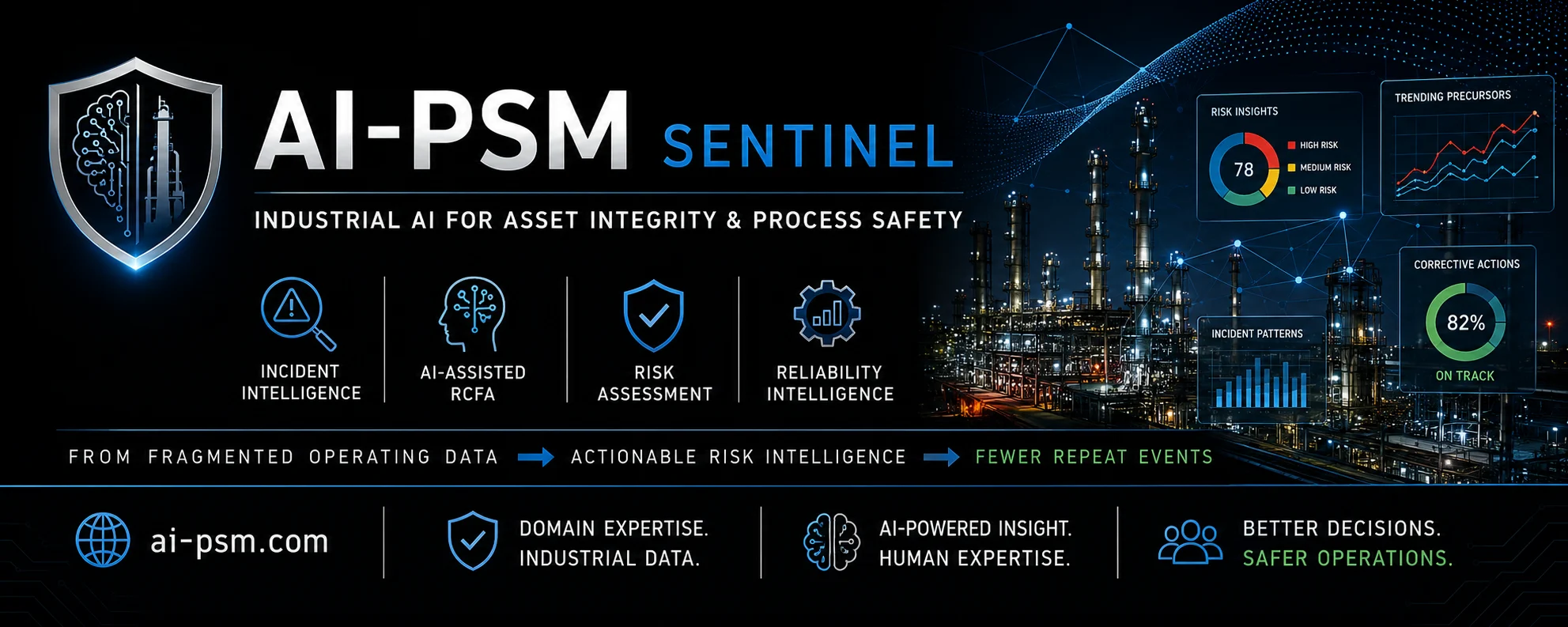
AI-PSM Sentinel is designed to connect your PSE history, RCFA, assets and barriers with governed RAGAGEP, public investigations and industry lessons — giving plant and enterprise leaders a broader lens on recurring risk, weak signals and improvement opportunities.
Plant-level proofEnterprise systemic learningRAGAGEP-informed contextHuman-reviewed decisions
ALREADY TESTED AGAINST INDUSTRY HISTORY
Thousands of public industrial events have already challenged the analytical engine.
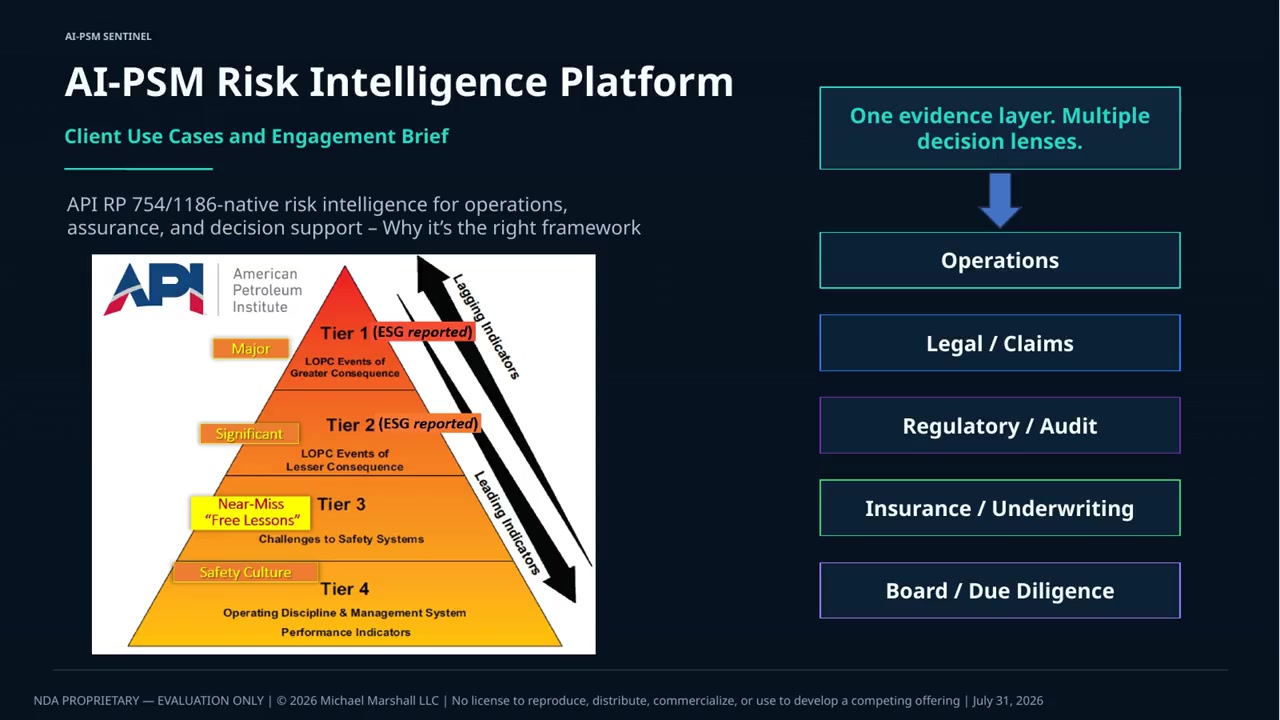
AI-PSM has been benchmarked and tested against thousands of publicly available industrial events and independent investigation findings to evaluate its ability to recognize causal patterns, equipment and failure-mode vulnerabilities, barrier weaknesses, repeat-event signals and corrective-action concerns.
AI-PSM ENTERPRISE INTELLIGENCE
Cross-Site Systemic Learning Assessment
Move beyond isolated site investigations to understand what the enterprise is learning — or failing to learn — across facilities.
Normalize and compare multi-site incident, near-miss, RCFA and corrective-action histories.
Identify recurring causal-factor combinations across facilities.
Recognize common equipment and failure-mode vulnerabilities.
Detect barrier degradation or management-system weaknesses appearing in different forms at different sites.
Evaluate whether lessons from one facility were effectively transferred to others.
Identify cross-site repeat-event patterns and enterprise corrective-action effectiveness concerns.
Create a prioritized set of corporate OFIs and shared lessons learned.
FUTURE INDUSTRY COOPERATIVE · PSE INTELLIGENCE HUB
What if the industry could learn collectively — without exposing any company’s confidential operating history?
The longer-term AI-PSM vision is a voluntary, permissioned PSE Hub in which participating operators can contribute appropriately anonymized and aggregated process-safety event, near-miss and lessons-learned information to a governed cooperative learning environment.
Contribute by choice
Participating organizations decide what eligible PSE and near-miss information may be anonymized, aggregated and used for cooperative learning.
Compare recurring patterns
Look across operators for recurring causal combinations, equipment and failure-mode vulnerabilities, barrier degradation and corrective-action effectiveness concerns.
Return shared learning
Give participants a broader view of industry experience that no single operator can recreate from its own history alone.
THE NETWORK EFFECTYour enterprise learns from itself. Participating companies learn from one another. The industry becomes better able to recognize risk before history repeats itself.
WHAT IT IS NOT
No use without authorization. No disclosure of another operator’s proprietary event records. The concept is built around governed, permissioned, anonymized and aggregated learning.
THE AI-PSM INDUSTRY INTELLIGENCE ADVANTAGE
Your plant should not have to learn every lesson the hard way.
AI-PSM is designed to compare what is happening inside your operation with a wider, governed body of engineering practice and industry experience — while leaving applicability, engineering judgment and regulatory conclusions with qualified people.
Your enterprise memory
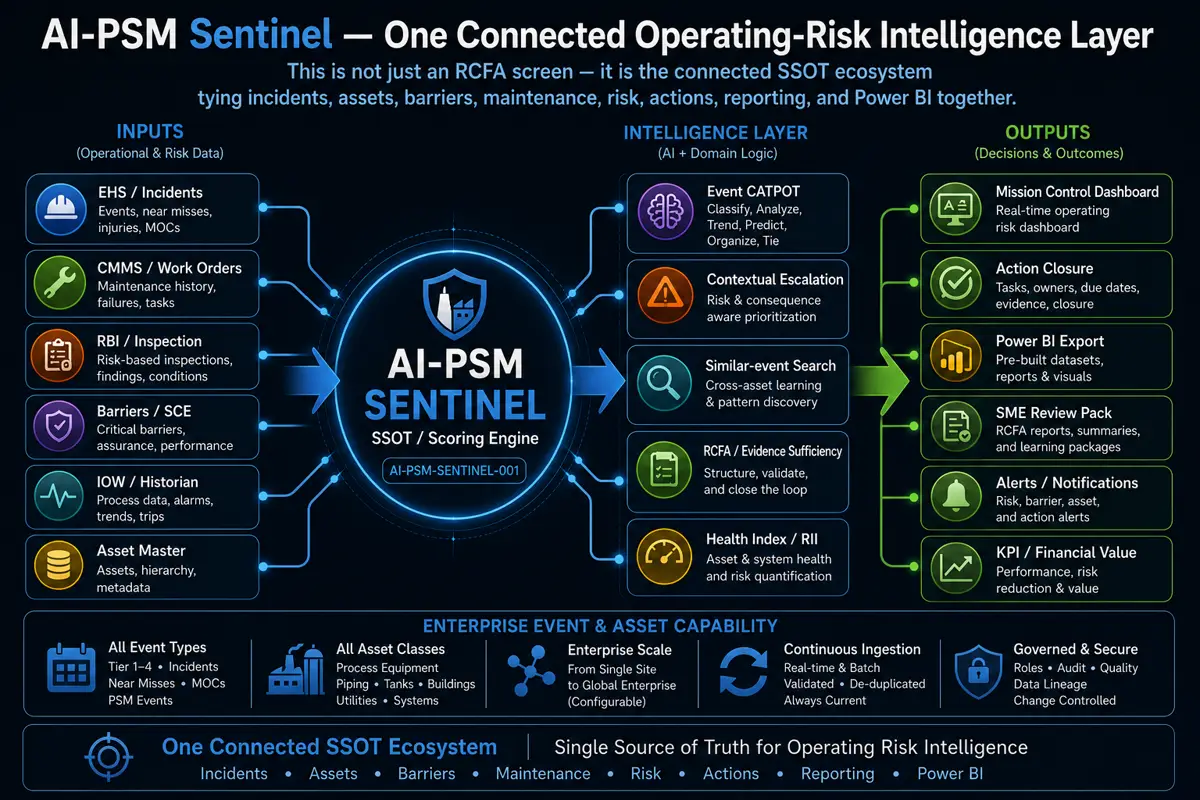
Incidents, near misses, RCFA, corrective actions, maintenance, inspection, assets, barriers and operating history across years and sites.
+
RAGAGEP + industry knowledge
Appropriately licensed standards, recommended practices, regulatory guidance, public investigations, technical literature and curated lessons learned.
+
PSE Hub cooperative learning
Future voluntary, permissioned, anonymized and aggregated peer patterns that can broaden learning across participating operators without exposing another company’s proprietary event records.
AI-PSM INTELLIGENCE LAYERFind relevant knowledge → compare it with site evidence → surface patterns → explain why they matter → route to SME review
WHY EXECUTIVES CARE
RAGAGEP awareness is not just a technical-library issue. It is an operating-risk issue.
OSHA’s PSM framework requires documented compliance with selected/applicable RAGAGEP for covered equipment and mechanical-integrity activities. EPA’s current RMP Program 3 guidance expects owners and operators to regularly review new and updated RAGAGEP and evaluate safety gaps created by new industry knowledge.
AI-PSM does not determine applicability or certify compliance. It is designed to help qualified teams surface relevant external knowledge that deserves review in the context of actual plant evidence.
AI-PSM IN 1:42
See the product story before the product demo.
For a plant manager or VP, this is the fastest way to understand the operating-risk intelligence concept and where AI-PSM fits.
AI-PSM Sentinel — Use Case Overview1:42 · narrated overview
A LOW-RISK WAY TO PROVE VALUE
Let your own history be the benchmark.
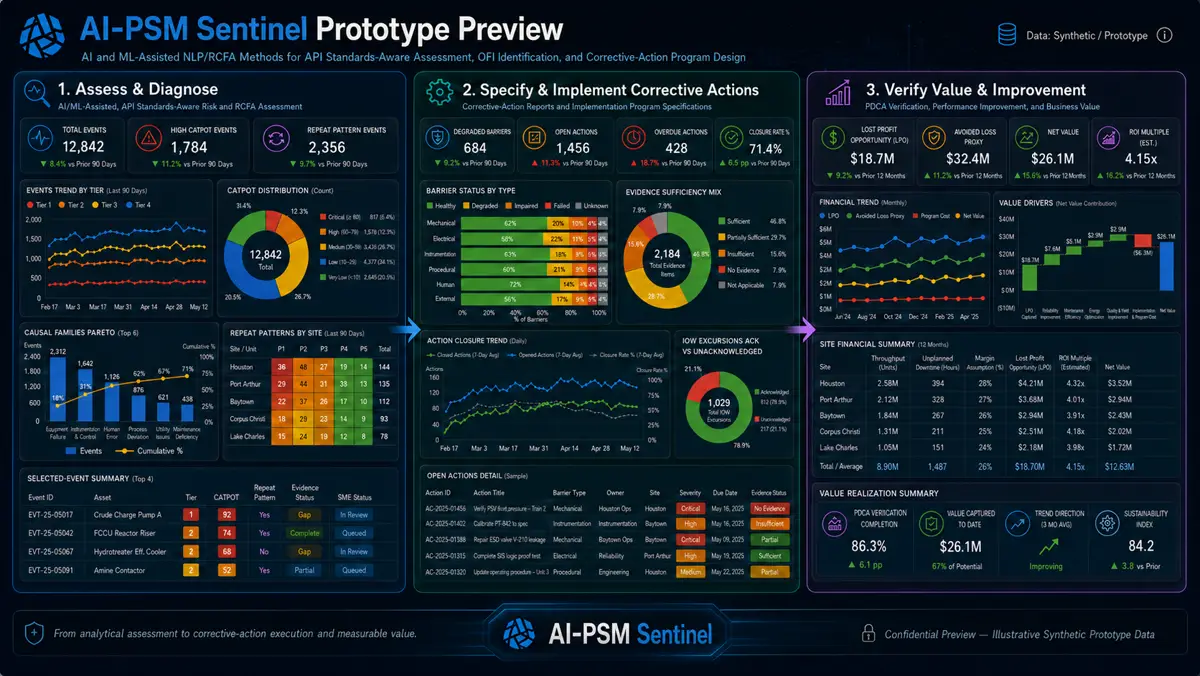
Instead of asking a new customer to trust a startup SaaS claim, start with a bounded Five-Year PSE Intelligence Assessment and compare AI-PSM’s output against investigations whose outcomes are already known.
Original RCFA findingsVS.AI-PSM incremental intelligence
- Additional causal and contributing-factor relationships
- Previously unconnected similar-event clusters
- Repeat events after prior corrective actions
- Cross-asset and cross-site systemic patterns
- Relevant RAGAGEP and industry lessons for SME review
01SiteWhat did our event-by-event investigations miss?
→02EnterpriseWhat did we fail to learn collectively?
→03IndustryWhat external lessons should reviewers consider?
→04SentinelHow do we identify it continuously?
WHY BUY AI-PSM INSTEAD OF BUILDING IT INTERNALLY?
Your company can buy an AI model. The harder part is maintaining the industrial intelligence system around it.
Apply AI to what your company knows.
Build the domain model, normalization, taxonomies, standards knowledge, retrieval, evaluation, security, governance, integrations and ongoing update process yourself.
Apply AI to what your company knows — in the context of what the industry has learned.
Start with a purpose-built process-safety and asset-integrity intelligence layer designed for cross-event, cross-site and external-knowledge reasoning — with a future permissioned PSE Hub that can add cooperative peer learning no individual operator can reproduce alone.
Keep scarce SMEs focused on judgment.
Use engineering and process-safety talent to challenge findings and act on risk rather than recreate every component of an industrial AI product.
PROVE FIRST. OPERATIONALIZE SECOND.
See what five years of your data — plus broader industry knowledge — can reveal.
Use the historical assessment as the value experiment. If the incremental intelligence is compelling, Sentinel becomes the continuous SaaS layer.